
DTG Printing – What Is Direct to Garment?
Digital textile printing is a modern digital printing process. DTG stands for "Direct to Garment" — meaning printed directly onto the fabric. It is used particularly for print on demand. It is a textile printing technique in which a digital motif is printed onto the fabric using a textile printer. This means that no complex preparation is required, such as with a screen printing process. As a result, costs can be saved and greater flexibility is achieved with cost-effective production for small and individual print runs.
The result of DTG printing depends critically on the fabric and the textile surface. Smoother surfaces achieve higher resolutions than coarser weaves. Cotton fabrics are excellent for digital textile printing, which predominantly uses water-based pigment ink.
DTG Printing Process
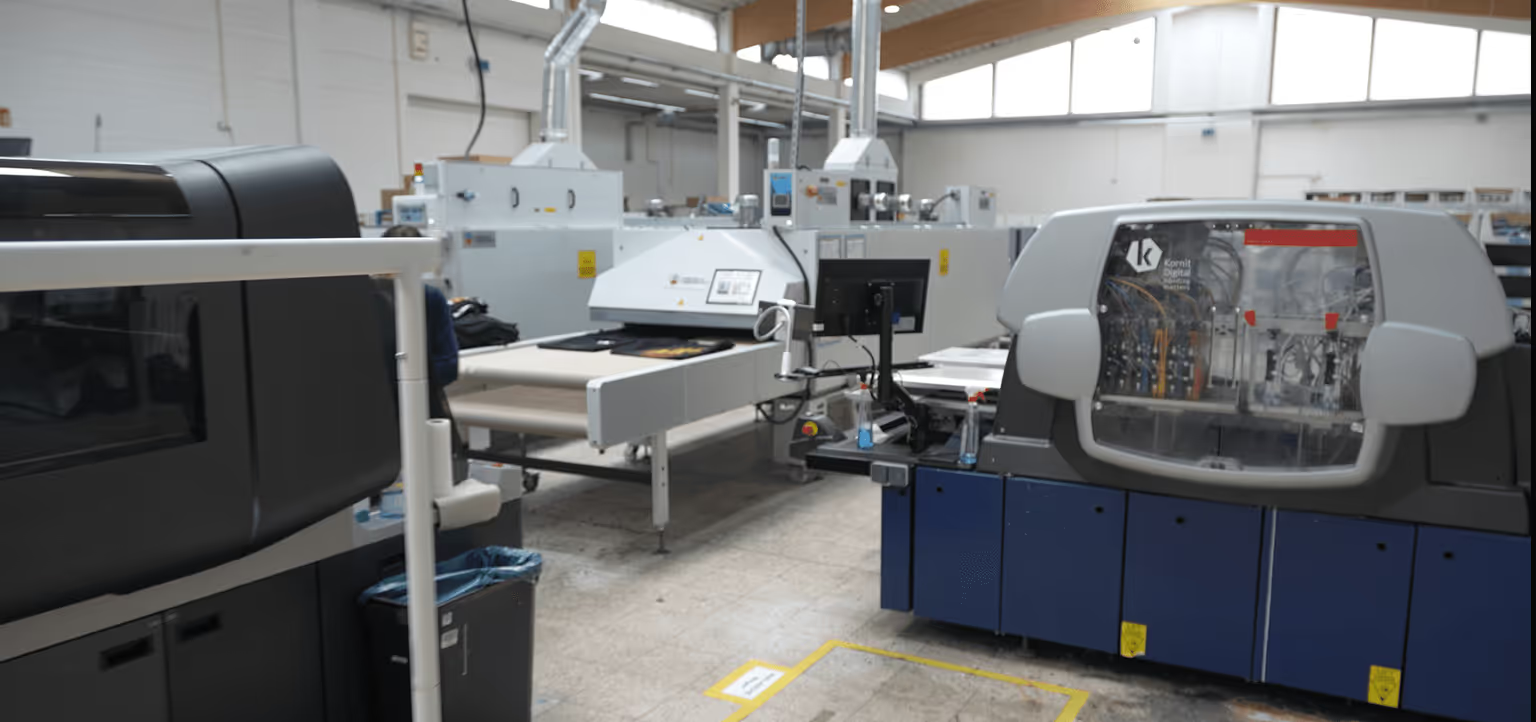
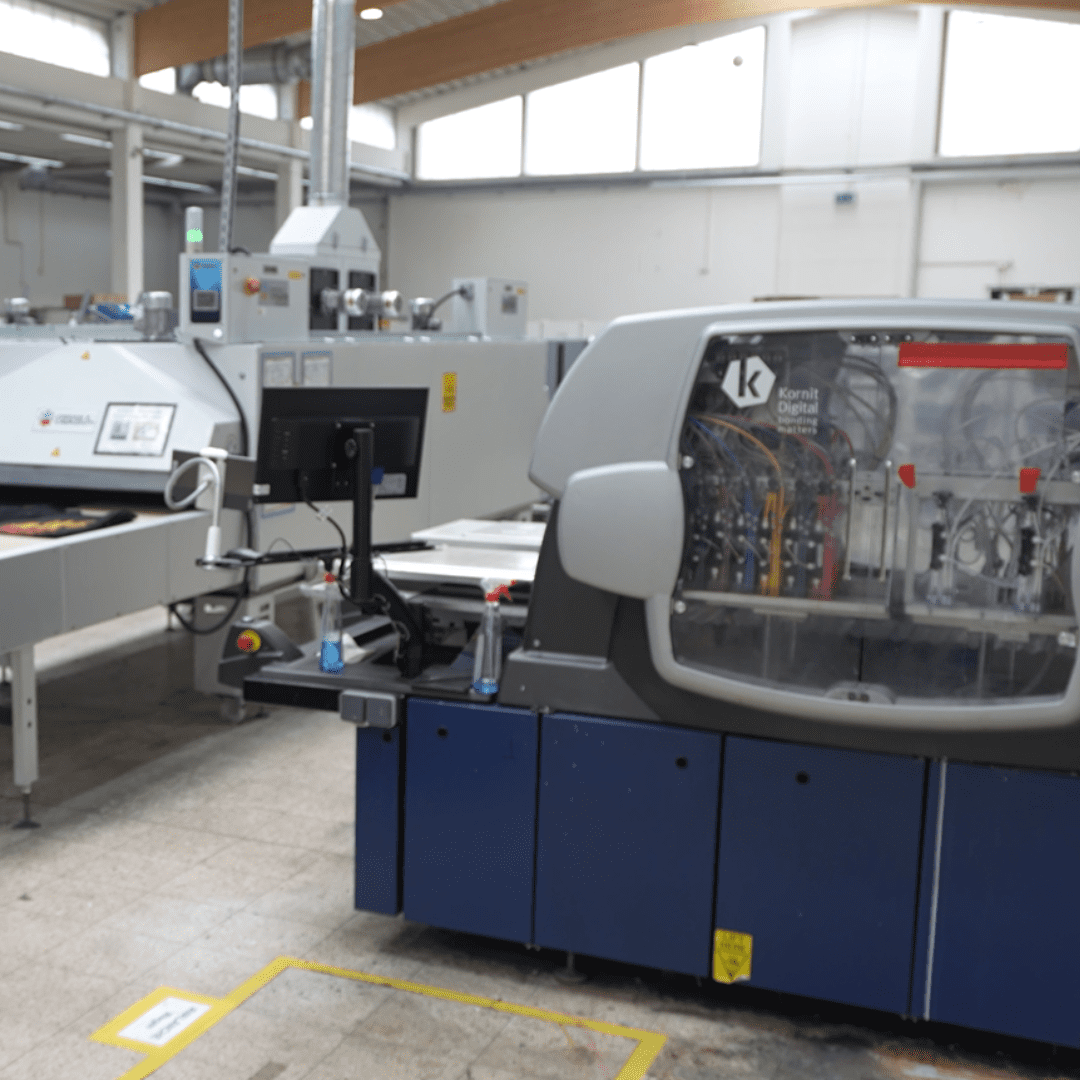
The printer used for DTG printing can be compared to an inkjet printer. Instead of printing on paper, the DTG printing machine prints on textiles. High-quality print heads and inks are used to transfer a motif onto the textiles. Depending on the printing system, different printing processes are distinguished, each influencing the result. Essentially, the DTG printing process consists of four stages: pre-treatment, design preparation, printing, and fixation.
Pre-Treatment
With white textiles, the colours are absorbed directly into the fabric, while with coloured textiles a white base is needed so that the colours appear vibrant. The so-called pre-coating applies white ink that adheres to the surface of the textile fabric. The fabric to be printed absorbs the white ink almost completely. The pre-treatment depends on the printing system. For example, with a Kornit printing machine, the pre-coating can be applied automatically during the printing process, while other machines require an external device.
Design Preparation
After the pre-coating, the graphics are prepared and the design is converted into a printable file. Depending on the printing machine and application, the design preparation may take place before the pre-coating. The preparation and conversion of the graphic often takes place in raster image processing using RIP software, which creates a white background. In the raster image process, the images can be converted into pixels through rasterisation and are forwarded to the printer as rasterised data.
Printing and Fixation
During the printing process, the white background is applied first and then the colours are printed. The ink is then fixed. This process fully bonds the ink with the textile and creates greater wash resistance. The fixation takes place in a tunnel dryer or a heat press. To achieve a good result, all stages must be well coordinated with one another.
Special printing inks are used to ensure long durability and wash resistance of the print. DTG printing primarily uses water-based pigment ink, which is particularly suitable for cotton fabrics and blended textiles.
Colours

To create a print file for DTG printing, colours must be set up in the RGB colour space. Conversion software handles the separation of colours into CMYK and white channels on the printing machine. The colours are automatically generated from CMYK and white. This gives direct textile printing a strong colour depth, in contrast to screen printing where the number of colours is limited. DTG printing is particularly well suited for photorealistic motifs with complex colour gradients.
File formats that support transparency are suitable for DTG printing, such as PNG, JPEG, TIFF, PSD, EPS, SVG, and AI. Especially with coloured fabrics, a transparent background or a cut-out motif is required. Rasterised layers, a reduced background, and semi-transparency with an alpha channel below 100% are necessary. The colours change depending on the background colour.
Neon colours, metallic colours, and spot colours are among the special colours that are difficult to reproduce in digital textile printing — neon colours in particular differ significantly between the original artwork and the final print. Spot colours, however, can be simulated and mapped in the CMYK colour space. For example, gold corresponds to an ochre tone, while silver is comparable to a grey shade.
Applications
In DTG printing, no stencil or film preparation is necessary as in screen printing. This makes the digital process particularly suitable for small and individual print runs. Costs are independent of quantity. For larger print runs, screen printing is more suitable because costs decrease as the quantity increases.
Direct textile printing is used primarily in e-commerce. Print on demand makes individual-quantity printing cost-effective and straightforward. Textiles are only produced and shipped after an order is received, eliminating storage and the associated costs. This gives the customer an affordable personalised textile.